
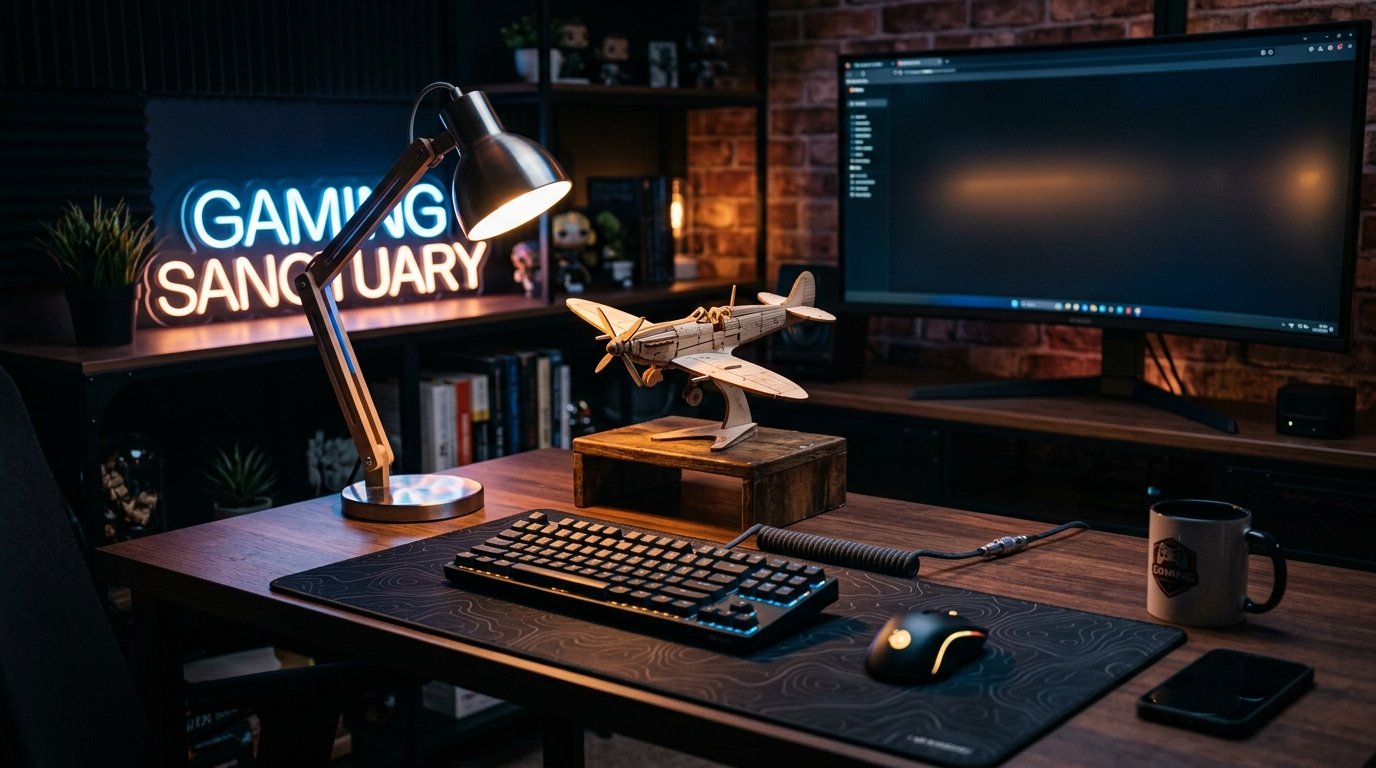
LED Neon: Wall Neon Signs for Gaming, Anime & Custom Designs
LED Neon: what really changes compared to glass neon
An LED neon sign isn't a miniaturized gas neon tube. It's a strip of SMD 2835 or 2216 LEDs encased in a flexible silicone tube 8 to 12 mm in diameter, powered by a 12V or 24V DC external transformer. This technical difference explains almost everything: power draw between 8 and 14W per meter depending on LED density, versus 40 to 60W for an equivalent gas neon tube. The stated lifespan runs around 30,000 to 50,000 hours depending on LED and driver quality, or 8 to 12 years with 8 hours/day of home use.
The silicone absorbs impacts and bends down to a curve radius of about 3 cm without breaking the internal circuit, which makes cursive shapes and handwritten-style lettering possible — something blown glass couldn't achieve without risking cracks at stress points.
Custom LED neon signs for bedroom and office
For a bedroom, light output matters more than shape. A 5-meter single-color flexible neon draws around 50W total and generates little heat: surface temperature stays under 45°C, compared to over 200°C for a halogen bulb. That's what allows it to be mounted directly against a painted wall or wallpaper without any risk of heat marks. For extended evening use, choose a model with a built-in dimmer rather than a simple switch: perceived brightness fades more smoothly with PWM dimming than with stepped power cuts.
In an office or gaming setup, models with dynamic effects (gradient, breathing, chasing) use a control chip built into the tube and are typically operated via RF remote or Bluetooth app. Check the stated range: beyond 8 meters indoors, Bluetooth connection becomes unstable behind a concrete wall.
Wall-mounted LED neon and shop window displays: what to check before buying
For a shop window, a 220V mains power supply with a Class II transformer is essential: a USB 5V neon sign is fine for a nightstand, but not for a storefront lit 10 hours a day, since a standard USB driver isn't built for prolonged continuous operation. IP rating matters here too: IP65 is recommended whenever the neon sign may be exposed to condensation in a poorly ventilated window display, while IP20 is sufficient for dry indoor use only.
- 220V mains power + Class II transformer for continuous commercial use
- Minimum IP65 rating if exposed to humidity or condensation
- Flexible silicone for curved shapes and handwritten-style lettering
- Rigid backing (PMMA or acrylic) for fixed text messages and logos
- PWM dimmer rather than a simple switch to adjust brightness without flicker
Rigid or flexible: a choice that depends on the shape you want
A rigid neon sign mounted on an acrylic panel suits geometric logos and block-letter text: the line stays crisp, with no visible micro-waviness on straight edges. Flexible neon, on the other hand, becomes necessary as soon as the design includes tight curves or a handwritten signature — it's the only option that holds a curve radius under 5 cm without a visible break point at the internal solder joints.
Mounting: 3M adhesive or wall bracket
Double-sided 3M VHB-type adhesive holds well on a smooth, dry painted wall, but loses its grip within a few weeks on a textured render or damp surface. On these surfaces, the screw-mounted brackets included with the tube remain the most reliable solution, especially for pieces over 2 kg such as large wall lettering.
Maintenance and real-world lifespan
Silicone gradually yellows under direct sunlight exposure: expect a noticeable loss of transparency after 2 to 3 years outdoors uncovered, versus over 8 years indoors away from direct light. A dry cloth is enough for routine cleaning; avoid alcohol-based products, which weaken the silicone over time. The driver remains the most common point of failure, well ahead of the LEDs themselves: a quality transformer often justifies a price difference of a few euros at purchase, easily paid back over the product's lifetime.
LED Neon: what really changes compared to glass neon
An LED neon sign isn’t a miniaturized gas neon tube. It’s a strip of SMD 2835 or 2216 LEDs encased in a flexible silicone tube 8 to 12 mm in diameter, powered by a 12V or 24V DC external transformer. This technical difference explains almost everything: power draw between 8 and 14W per meter depending on LED density, versus 40 to 60W for an equivalent gas neon tube. The stated lifespan runs around 30,000 to 50,000 hours depending on LED and driver quality, or 8 to 12 years with 8 hours/day of home use.
The silicone absorbs impacts and bends down to a curve radius of about 3 cm without breaking the internal circuit, which makes cursive shapes and handwritten-style lettering possible — something blown glass couldn’t achieve without risking cracks at stress points.
Custom LED neon signs for bedroom and office
For a bedroom, light output matters more than shape. A 5-meter single-color flexible neon draws around 50W total and generates little heat: surface temperature stays under 45°C, compared to over 200°C for a halogen bulb. That’s what allows it to be mounted directly against a painted wall or wallpaper without any risk of heat marks. For extended evening use, choose a model with a built-in dimmer rather than a simple switch: perceived brightness fades more smoothly with PWM dimming than with stepped power cuts.
In an office or gaming setup, models with dynamic effects (gradient, breathing, chasing) use a control chip built into the tube and are typically operated via RF remote or Bluetooth app. Check the stated range: beyond 8 meters indoors, Bluetooth connection becomes unstable behind a concrete wall.
Wall-mounted LED neon and shop window displays: what to check before buying
For a shop window, a 220V mains power supply with a Class II transformer is essential: a USB 5V neon sign is fine for a nightstand, but not for a storefront lit 10 hours a day, since a standard USB driver isn’t built for prolonged continuous operation. IP rating matters here too: IP65 is recommended whenever the neon sign may be exposed to condensation in a poorly ventilated window display, while IP20 is sufficient for dry indoor use only.
- 220V mains power + Class II transformer for continuous commercial use
- Minimum IP65 rating if exposed to humidity or condensation
- Flexible silicone for curved shapes and handwritten-style lettering
- Rigid backing (PMMA or acrylic) for fixed text messages and logos
- PWM dimmer rather than a simple switch to adjust brightness without flicker
Rigid or flexible: a choice that depends on the shape you want
A rigid neon sign mounted on an acrylic panel suits geometric logos and block-letter text: the line stays crisp, with no visible micro-waviness on straight edges. Flexible neon, on the other hand, becomes necessary as soon as the design includes tight curves or a handwritten signature — it’s the only option that holds a curve radius under 5 cm without a visible break point at the internal solder joints.
Mounting: 3M adhesive or wall bracket
Double-sided 3M VHB-type adhesive holds well on a smooth, dry painted wall, but loses its grip within a few weeks on a textured render or damp surface. On these surfaces, the screw-mounted brackets included with the tube remain the most reliable solution, especially for pieces over 2 kg such as large wall lettering.
Maintenance and real-world lifespan
Silicone gradually yellows under direct sunlight exposure: expect a noticeable loss of transparency after 2 to 3 years outdoors uncovered, versus over 8 years indoors away from direct light. A dry cloth is enough for routine cleaning; avoid alcohol-based products, which weaken the silicone over time. The driver remains the most common point of failure, well ahead of the LEDs themselves: a quality transformer often justifies a price difference of a few euros at purchase, easily paid back over the product’s lifetime.