
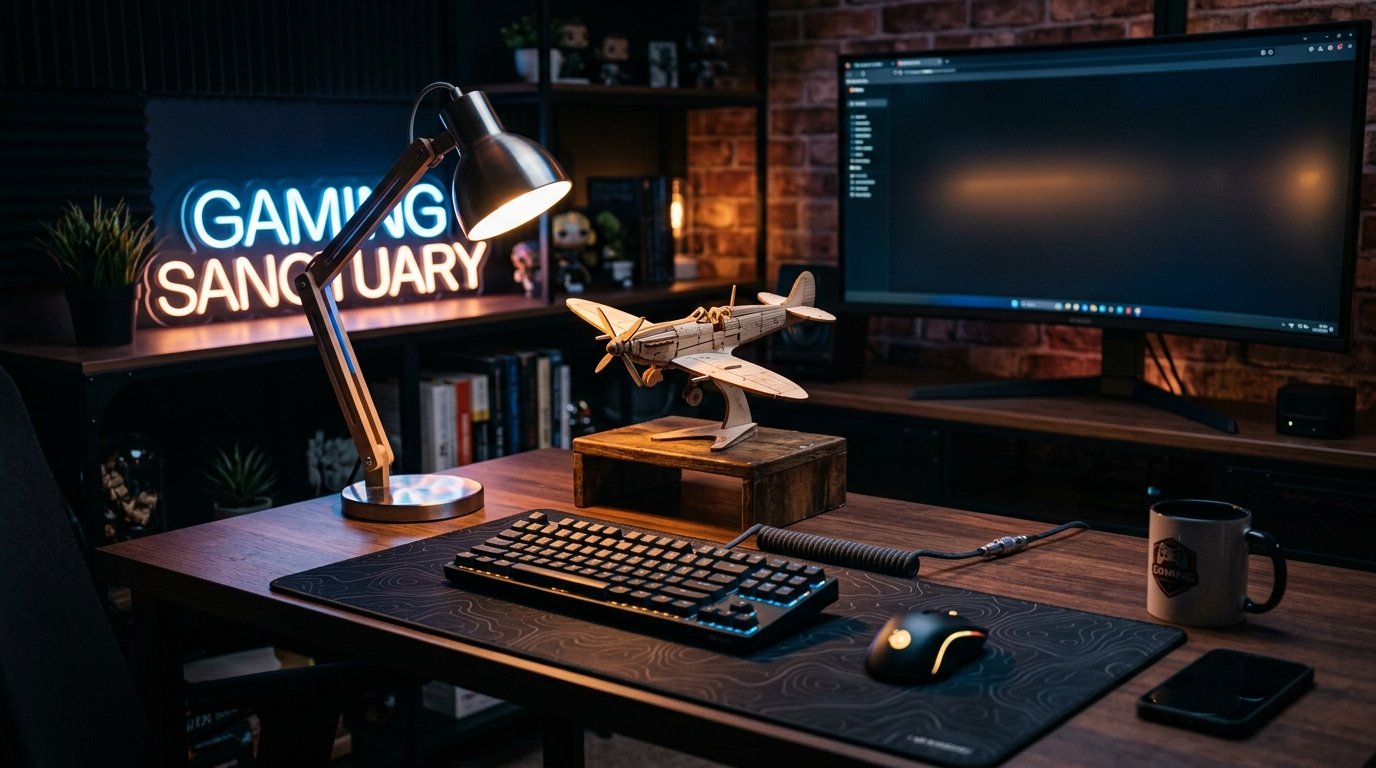
LED Desk Lamp: Office, Bedroom & Gamer/Teen Lighting
Showing all 12 results
-

Adjustable LED Desk Lamp
-

Crystal ball LED lamp – saturn
-

Crystal ball led lamp – solar system
-

Galaxy crystal ball LED lamp
-

Jellyfish LED Crystal Ball Lamp
-

LED Computer Desk Lamp
-

Levitating LED Globe Lamp
-

Magnetic LED Light-Up Globe
-

Magnetic Levitation Lamp with LED Bulb
-

Retro Glass Bedside Lamp
-

Touch LED Desk Lamp
-

Vintage Orange Mushroom Lamp
Price range: £44.90 through £50.90 🛒 This product has multiple variants. The options may be chosen on the product page
LED desk lamp: the criteria that really matter
An LED desk lamp should be chosen based on measurable data, not the look of the housing. Luminous flux, color temperature and color rendering index determine whether your eyes hold up for 8 hours in front of a screen or start straining after 90 minutes. A designer calibrating on-screen colors under an LED desk lamp with a CRI of 70 is working from skewed reference points without even realizing it.
Brightness: don’t trust the wattage on the box
Lumens measure the light actually emitted, watts measure power consumption — the two haven’t been directly linked since LEDs took over. An 8W LED desk lamp can put out 600 lumens where an old 40W halogen only managed 500. For standard office work, 400 to 800 lumens is enough. For technical drawing or sewing, go up to 900-1000 lumens: below that, your eyes compensate by leaning closer to the work surface, which speeds up visual fatigue after 2 to 3 hours.
Color temperature: match it to the time of day
3000K gives a warm amber light, close to a classic incandescent bulb — useful in the evening since it doesn’t delay melatonin release. 4000K roughly matches an overcast midday sky, a solid compromise for continuous office use. Above 5000K, the light approaches midday sunlight and suits alertness-heavy tasks: proofreading dense documents, quality control, night work that needs to simulate daylight.
CRI: the number product sheets often hide
The color rendering index is scored out of 100, with sunlight as the 100 reference. Below 80, reds and greens visibly dull — a real problem for anyone editing photos or matching fabric shades. Lamps under €15 rarely state this index: that’s a warning sign in itself, not an innocent marketing omission.
Articulated, clip-on or rechargeable LED desk lamp: three distinct uses
A multi-jointed articulated arm lets you aim the beam precisely onto an A4 sheet or keyboard, without lighting up the wall behind the screen. The clip-on lamp attaches to a surface under 5 cm thick and frees up the entire desktop — a real advantage on an 80×60 cm desk already crowded with a dual-monitor setup.
- Corded articulated model: maximum stability, suited to a fixed workstation, no battery-life limit
- USB-C rechargeable model: 4 to 10 hours of battery life depending on capacity, handy in a library or coworking space, though brightness gradually drops as the charge runs low
Connected versions with a touch dimmer add fine-tuned brightness control and sometimes color temperature adjustment via an app. On entry-level models, this dimmer often works in 20% increments, which is fairly coarse compared to a continuous analog dimmer.
Mistakes that cost you in daily use
A base under 15 cm in diameter tips over as soon as a 45 cm articulated arm is extended horizontally — check the base’s weight before buying, not just its shape. Flicker invisible to the naked eye, caused by a low-quality LED driver running on low-frequency PWM (below 300 Hz), triggers headaches after a long session without the cause being obvious right away.
- Overlooking the lighting angle: a lamp mounted too high casts the hand’s shadow over the writing for a right-hander working toward the left
- Choosing on price alone: low-CRI LEDs are cheaper to produce, hence their aggressive pricing
- Skipping the dimmer: a single fixed brightness level suits neither morning work nor evening reading
Lifespan and real-world upkeep
A decent-quality LED lasts between 25,000 and 50,000 hours, roughly 15 to 30 years at 4 hours of daily use. Unlike a halogen bulb that burns out abruptly, an LED loses brightness gradually (known as lumen depreciation): once it drops below 70% of its initial output, replacing the whole lamp makes sense, since the LED itself usually can’t be swapped out on its own. Dusting the diffuser once a month with a dry cloth prevents the brightness loss caused by dust buildup, which matters more than component wear itself.
What brightness should I choose for an LED desk lamp?
Aim for 400 to 800 lumens for everyday office work. For technical drawing, sewing or any precision task, go for 900 to 1000 lumens with a dimmer to adjust based on ambient light.
What’s the difference between a 3000K and a 6500K lamp?
3000K reproduces a warm amber tone close to an incandescent bulb, suited to evening reading without disrupting sleep onset. 6500K mimics daylight and suits tasks that demand sustained alertness during the day.
Can a rechargeable LED desk lamp handle intensive daily use?
Yes, if the stated battery life exceeds 6 hours and it charges via fast USB-C. For a fixed workstation used more than 6 hours a day, a corded version avoids the repeated charge cycles that wear down the battery over time.
How can I reduce eye strain with an LED lamp?
Choose a CRI above 80, a brightness dimmer and an adjustable color temperature between 3000K and 5000K. Position the arm so the beam falls on the work surface, never directly in your line of sight or reflected off the screen.
Who is the clip-on LED desk lamp best suited for?
For desks under 1 m² or surfaces already crowded with one or two monitors. It clips onto an edge under 5 cm thick and frees up the work surface, at the cost of less stability than a classic weighted base.
Getting that CRI number right matters just as much outdoors, where growers calibrating leaf color under grow lights face the same skewed-reading problem — and once the desk setup is sorted, drip irrigation kits and sprinklers from hosepipeshop.co.uk handle the watering schedule for whatever’s growing on the windowsill nearby.